
The short answer
- Why Paje: a wide, shallow, warm lagoon with steady wind for much of the year, which is forgiving for beginners.
- How long to learn: about 9 to 12 hours of lessons, usually over 3 to 4 days, to ride independently. Upwind riding takes longer.
- Best months: June to October for strong, steady wind, and December to March for moderate wind that suits learners.
- Tide matters: the lagoon is very shallow at low tide, so most lessons run around mid to high tide.
- Cost: from about $110 for an intro lesson and $450 for a 9-hour beginner course, with equipment included.
- Always: learn with a qualified instructor, use a helmet and impact vest, and never ride in wind that is too strong for you.
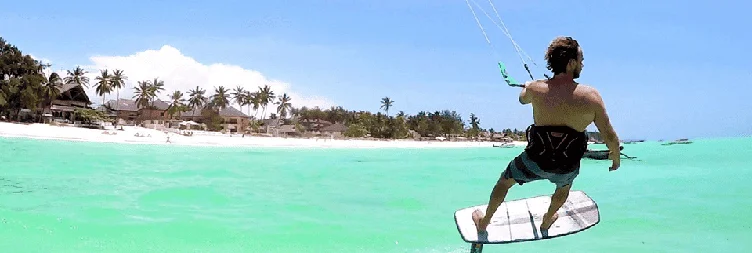
Paje, on Zanzibar's east coast, is the best-known place in East Africa to learn kitesurfing. A long white beach, a wide shallow lagoon, warm water and steady wind give beginners the one thing they need most: room to make mistakes safely. If you have never held a kite, this guide explains how lessons work, how many hours you will realistically need, when to come, how the tide changes the day, what to wear, how to stay safe and how to choose a school. It is written by a local operator who runs trips on this coast, and it is updated for 2026 and 2027. For our own lessons and gear hire, see our kitesurfing in Paje page.
Why learn kitesurfing at Paje
- Flat water: the lagoon inside the reef is wide and shallow, with very little swell, so you are not fighting waves while you learn.
- Warm water: the sea stays warm all year, so you can practise for hours without a thick wetsuit.
- Steady wind: the wind blows reliably for long stretches of the year, so you spend more time riding and less time waiting.
- Space: the lagoon is large, so beginners can practise away from more advanced riders.
- Standing depth: in much of the lagoon you can stand or walk back with your board, which makes recovery easy.
- A holiday setting: cafes, guesthouses and boutique hotels sit right behind the beach, and the rest of Zanzibar is within reach for rest days.
Paje is not perfect for everyone. Wind and tide set the schedule, and the east coast is windy, which suits kitesurfing but not lazy sunbathing. See our comparison of Nungwi, Kendwa and Paje if you are deciding where to stay.
Kitesurfing basics
In kitesurfing you stand on a small board and are pulled across the water by a large controllable kite. The kite is attached to a control bar by lines, and the bar is clipped to a harness around your waist, so your body, not just your arms, takes the pull. You steer the kite by pulling one side of the bar, and the kite's position in the sky decides how hard it pulls.
The wind window
The "wind window" is the area of sky in which the kite flies. At the edge of the window, directly downwind of you and low, the kite has little power. Overhead, it is lighter. The power zone, in between, is where the kite pulls hardest. Learning to read and use this window is the core of kite control, and it is the first thing a good instructor teaches.
Safety systems
A modern kite has a quick-release on the bar that you can pull to depower the kite, and a leash that keeps you attached to it when you do. Your instructor will practise these with you until they are automatic. They are the most important part of your equipment, and a school should never let you ride without understanding them.
Who can learn, and how hard is it?
Most healthy people can learn to kitesurf. It is less strenuous than it looks, particularly in flat water with a harness, but it does ask for some fitness, balance and patience. The first few hours are the hardest, because you are learning to control a kite and to cope with being dragged through water, long before you actually stand on the board.
- Swimming: you should be a confident swimmer, because you will spend time in the water.
- Age and weight: many schools set a minimum age of around 12, with weight and swimming requirements. Ask your school, because rules vary.
- Fitness: general fitness is enough, and core and leg strength help. Previous experience of snowboarding, wakeboarding, surfing or windsurfing can speed things up, but is not needed.
- Health: tell your instructor about any injury, back, shoulder or knee problem, heart condition or medication.
- Mindset: expect to feel clumsy on day one. Everyone does, and it comes together quickly.
The learning stages
A good beginner course follows a clear sequence, and you should not move to the next step until the one before is solid. Here is how it normally goes.
- About 1 to 2 hoursTheory, wind and safetyYou learn wind direction, the wind window, launch and landing signals, right-of-way rules, and how to use the safety systems. You then fly a small trainer kite on the beach to feel how it responds.
- About 1 to 2 hoursKite control on land and in shallow waterYou move to your full-size kite, learn to launch and land it with an assistant, and practise steering it smoothly. Good kite control is the foundation for everything else.
- About 2 to 3 hoursBody draggingIn the water, you let the kite pull you through without a board, learning to steer it, control your direction and recover your board. This is hard work, but it builds the skills you need for riding.
- About 2 to 3 hoursWater startsYou put on the board, learn to position it, power the kite and rise to your feet. Most people have their first short rides in this stage, and then many failed attempts before it clicks.
- About 2 to 4 hoursRiding and controlling directionYou ride in both directions, learn to stop, change direction and handle gusts. You start to work on holding your line and edging against the wind.
- More hours after the basicsRiding upwindBeing able to ride back to where you started is the key skill that makes you independent. It takes extra practice for most people, and many schools treat it as a separate step.
Most beginners need around 9 to 12 hours of instruction to ride independently in a straight line, and 12 to 16 hours or more to be able to stay upwind with confidence. Everyone learns at their own pace. A good instructor tells you honestly where you are after each session.
A sample 3-day beginner course
| Day | Focus | Typical content |
|---|---|---|
| Day 1 | Kite control and body dragging | Theory, trainer kite, safety systems, launching and landing, body dragging in the lagoon |
| Day 2 | Water starts | Board recovery, getting the board on, first water starts and short rides |
| Day 3 | Riding | Riding in both directions, stopping, changing direction, an introduction to riding upwind |
Each session is usually about three hours, and schools plan them around wind and tide, so the days may move. Many schools add extra hours at a discount if you need them.
Course length planner
How many hours will you need?
A rough guide based on typical progress, not a promise. Your instructor will tell you where you are.
Wind and the best time to kitesurf in Paje
Paje's wind comes from two monsoon systems. From about June to October, the south-easterly kusi blows strongly and steadily, and from about December to March the north-easterly kaskazi blows more lightly and moderately. In between, the wind is more variable. These are general patterns, and individual days vary, so treat the figures as a guide, not a forecast.
| Months | Wind | Best for | Notes |
|---|---|---|---|
| June to October | Strong and steady (kusi) | Experienced riders, fast progress, small kites | Busiest in July and August. Learners need good instruction to manage gusts and strong pull. |
| December to March | Light to moderate (kaskazi) | Learners and improvers | Hot and humid, with lighter winds and warm water. December and January are busy. |
| April and May | Light and variable, long rains | Quiet beach time | Wind and lessons are less reliable, and some schools close. |
| November | Changeable | Value, fewer crowds | Short rains begin. Some light-wind days. |
Pick a month
How good is each month for kitesurfing?
A rough guide to the typical conditions. Ratings are out of five.
Typical wind speeds and kite sizes
Wind speed is measured in knots, and kites come in different sizes, measured in square metres. In general, you need a bigger kite in lighter wind, and a smaller one in strong wind, and a lighter rider can use a smaller kite. Most learners start in light to moderate wind, roughly 12 to 20 knots, where the kite pulls enough to move you but not so much that it is hard to control. The table below is only a rough guide for a typical twin-tip kite, and your instructor chooses the right kite for you on the day.
| Wind (knots) | Feel | Typical kite for a 70 to 80 kg rider |
|---|---|---|
| 10 to 14 | Light | 12 to 14 m |
| 15 to 18 | Moderate, ideal for learning | 10 to 12 m |
| 19 to 23 | Fresh | 8 to 10 m |
| 24 and above | Strong, for experienced riders only | 7 to 8 m or smaller |
Learners should not ride in strong wind, and a good school will move a lesson to a calmer time or day rather than push on. If your school sends beginners out in strong, gusty conditions, that is a warning sign.
Tides and the lagoon
Paje faces a wide lagoon protected by a reef, and the tide changes it dramatically. At high tide, the water is deep enough for riding across most of the lagoon. At low tide, the sea retreats a long way, the lagoon becomes very shallow, and large areas are exposed sand and seaweed flats, with rock and urchins in places. Most lessons run from about mid-tide to high tide, and schools plan the day around the tide table.
- High tide: the best time to ride, with the most water and room.
- Mid-tide: good for lessons, with enough depth and the ability to stand in much of the lagoon.
- Low tide: too shallow to ride in most places. Use the time for rest, theory, a walk on the sandbanks or a trip to Jozani Forest or Kuza Cave.
- Reef and urchins: wear booties or reef shoes, because sea urchins and sharp rock are present at the edges.
Check the tide times when you arrive, and ask your school how they schedule around them. If you are visiting only for a few days, look for a school that is flexible about start times.
Gear and what to wear
Schools normally provide the main equipment for lessons, so you do not need to buy anything before you come.
Safety
Kitesurfing has real risks, especially from strong wind, gusts, other riders, obstacles on the shore and mistakes with the kite. The risks are greatly reduced by good instruction, modern equipment, suitable conditions and following the rules. Please take this section seriously.
- Learn with a qualified instructor. Never try to teach yourself, and do not learn from friends who are not instructors.
- Use a helmet and impact vest. They protect you from falls and from board and kite impacts.
- Know your safety systems. Practise the quick-release and the leash until you can use them without thinking.
- Check the wind and weather before every session. Do not ride in squalls, thunderstorms or offshore wind, or wind that is too strong for your kite.
- Launch and land only with an assistant, and in a clear area, away from people, roads, power lines and other kites.
- Know the right-of-way rules. Riders on different tacks, upwind and downwind, and when overtaking, follow set rules. Your instructor will teach them.
- Stay out of the lanes of more advanced riders, and keep a long distance from the shore, swimmers, boats and the reef edge.
- Tell someone where you are going, ride with a buddy or in sight of the school, and know where the rescue boat is.
- Check your insurance. Make sure your travel insurance covers kitesurfing, and a medical evacuation.
Choosing a kite school in Paje
The school matters more than almost anything else. A good one gets you riding sooner and keeps you safe, and a bad one can put you off for good. Ask these questions before you book.
- Are the instructors certified? Look for recognised certification, such as IKO or VDWS, and ask how many years each instructor has taught.
- What is the student-to-instructor ratio? One or two students per instructor is ideal for beginners.
- Do they use radio helmets? Being able to hear your instructor on the water speeds up learning and improves safety.
- What is the rescue set-up? Ask about a rescue boat or jet ski, and what happens if you drift away.
- How old and well maintained is the equipment? Modern kites with working safety systems matter.
- How do they handle wind and tide? A good school reschedules lessons for safe conditions, and tells you honestly if the day is not suitable.
- What does the course price include? Check equipment, helmet, vest, radio and any insurance, and whether extra hours are discounted.
- What do recent students say? Read recent reviews from the last year or two.
What it costs
These are our current starting prices per person, including equipment and safety gear. They are rounded for planning, and the exact price depends on the dates and your group. Other schools in Paje price their courses similarly, but they differ, so compare what each includes.
| Option | Starting price | What it covers |
|---|---|---|
| Intro lesson (2 hours) | From $110 | Safety, wind basics, trainer kite, first steps in the water |
| Beginner course (9 hours) | From $450 | Kite control, body dragging, water starts and first rides |
| Improver coaching (3 hours) | From $180 | Upwind riding, transitions and feedback |
| Gear hire (half day) | From $60 | For independent riders. Proof of level may be required |
Besides lessons, budget for accommodation, food and transfers, and for insurance that covers kitesurfing. See our Zanzibar budget guide for typical daily costs, and our kitesurfing page to request a quote.
Common beginner mistakes
- Rushing to the board. Skipping kite control and body dragging slows you down in the long run.
- Pulling too hard on the bar. Small, smooth movements steer the kite, and big pulls make it unstable.
- Letting the kite fall behind you. Keep it in the power zone and in front of you.
- Looking at the kite, not where you are going. Look ahead, and your body follows.
- Riding when it is too windy. Strong wind is how most accidents happen. Wait for better conditions.
- Ignoring the tide. Riding in water that is too shallow hurts your feet and your board.
- Skipping sun protection and water. Long sessions in the sun lead to burnt skin, dehydration and exhaustion.
- Giving up too early. Almost everyone hits a wall around water starts, and it often clicks in the next session.
Where to stay and what else to do
Paje is a small village with guesthouses, boutique hotels and beachfront lodges, and most are within walking distance of the kite schools. The north coast is a better choice if you want deep water for swimming at any tide, but Paje is the place to learn. See our guide to where to stay in Zanzibar.
On low-tide hours and rest days, there is plenty to do nearby: Jozani Forest for red colobus monkeys, Kuza Cave for a swim, the seaweed farms at low tide, the Kizimkazi dolphin trips and lunch at The Rock restaurant. Non-kitesurfing partners can take a yoga class, relax at a beach cafe or take the Safari Blue dhow trip. For a trip that combines lessons with a proper holiday, see our 7 Day Zanzibar Beach Holiday and our guide to how many days you need.
What comes after the beginner course
Once you can ride and stay upwind, you are independent, and you can hire gear or buy your own. From there, the usual next steps are improving your transitions (changing direction smoothly), riding on both tacks with confidence, learning to jump safely and eventually riding in waves or on a foil board. Improver coaching and video feedback help a lot at this stage. Kitesurfing is a sport you can continue on holidays around the world, with the same certification and skills.
Kitesurfing in Paje: frequently asked questions
Ready to learn to kitesurf in Paje?
Tell us your dates, experience and group, and we will check availability and suggest a course and where to stay. We reply within 12 hours. No payment now.